 GensetPedia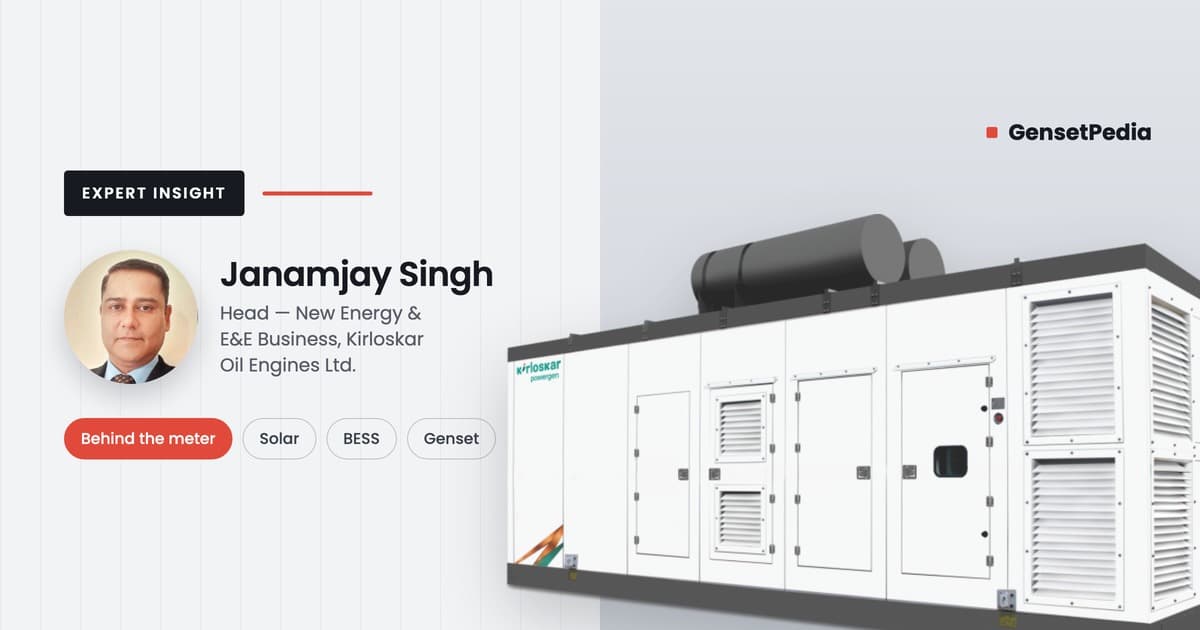
Behind the Meter: Grid, Solar, Storage and Generation on One Indian Site

By Janamjay Singh, Head — New Energy and E&E Business, Kirloskar Oil Engines Limited
· 6 min read
Janamjay Singh heads the New Energy and E&E business at Kirloskar Oil Engines Limited, working on behind-the-meter power — hybrid systems combining grid supply, solar, battery storage and generation. He is based in Pune, and writes on where distributed energy in India is heading.
View LinkedIn profile →The take
I spend my working life on the customer side of the energy meter, and the change I see there is not that one technology is replacing another. It is that four of them — grid, solar, storage and generation — now arrive on the same busbar, and something has to decide between them continuously. Generate, store, optimise, consume: that is both how a site gets built and, read backwards, how I think it should be specified.
I want to make an argument about where the next change in Indian power actually happens, and it is not at the power plant. I think it happens behind the meter.
That is not a slogan about renewables displacing engines. It is a description of what I see at customer sites. The boundary meter used to mark the end of an interesting conversation — the grid arrived, and whatever happened downstream was a matter of distribution boards and a standby set in the yard. Today the downstream side is where the design work is.
What customers ask for now is a longer list than it used to be: reliable power, energy-cost optimisation, renewable integration, peak-load management, carbon reduction, energy resilience. Only the first and the last of those six are the traditional backup brief. The other four are about the electricity bill, the disclosure report and the shape of the load — and a standby set was never bought to answer them.
So the practical question is what a site behind the meter is now made of, and what each part is genuinely for. Four things turn up on the same busbar — grid supply, a solar array, battery storage, and a generating set — and each covers a different kind of event. Generate, store, optimise, consume. That is a useful order to think in, because it is also the order in which the decisions get made.
Generate
Generation is the oldest part of this stack and the part I do not expect to disappear, for a reason that has nothing to do with what my company makes.
It is the only asset behind the meter with its fuel sitting in a tank. Solar generates when the sun is on the array. A battery delivers until its state of charge runs out. A grid connection works until it does not. A generating set with a full tank runs through a night, a monsoon week, or a feeder fault that lasts two days — and on most Indian sites, nothing else will.
What has changed is everything around it. Generation is still the floor under the site. It is no longer the whole building, and anyone in my industry who says otherwise is describing a market that has moved on.
Store
Storage is what changed the arithmetic, and it did so by taking over the short events.
Most of what interrupts an Indian site is brief — a feeder trip that clears in ninety seconds, a voltage dip, a switching event. Historically a set was started for every one of them: a cold engine cranked, run for a few minutes, and shut down again. That is the most punishing duty you can give a diesel, and some sites do it several hundred times a year. A battery covers those events with nothing mechanical happening at all. It also does two things the set cannot — it absorbs midday solar for the evening, and it shaves the demand peaks that appear as their own line on a commercial tariff.
The consequence for the machine is easy to state and easy to miss. The set starts less often and runs for fewer hours, and when it is finally called, it is called for the events storage could not cover: the long ones. Its annual hours fall. Its importance, per hour, rises.
Optimise
This is where I think the real innovation sits, and it is not inside any of the four boxes.
Imagine an architecture where grid, solar, storage and generation work together through an intelligent energy management system. Each asset performs a different role, and something has to arbitrate between them continuously. Is grid power available, and in which tariff band right now? Is the array producing? What is the state of charge, and is the site heading into a peak worth shaving? Should the set start, or is there enough stored energy to wait? Should the set, once running, also charge the battery rather than sit lightly loaded?
Every one of those decisions used to be made by a person, a timer, or nobody at all. Consolidating them is what turns four machines into one system. The future is unlikely to be about choosing one technology. It will be about intelligently integrating technologies around the customer's load profile.
For a buyer, that translates into an unglamorous specification question, and I would put it near the top of the list: can this generating set's controller participate? Will it accept remote start and stop from a third-party energy management system, report status over a standard protocol, and hold a commanded load level rather than simply following the bus? A set that cannot take instruction is not integrated into anything. It is a machine parked next to the system.
Consume
The last of the four is the one that decides what you buy, because it is the only one about your site specifically.
A connected-load total tells you very little — those loads never all run at once. A load profile tells you what actually happens: the overnight base, the shape of the working day, the size of the largest single step, when the peaks fall, how long a typical outage lasts. Solar is sized against the daytime part of that shape. Storage is sized against the short events and the peaks. Generation is sized against what genuinely remains — and in a hybrid installation, what remains is often handed over in a single step as the battery reaches its floor, rather than climbing gently the way a grid restoration does.
That detail is where I see hybrid installations go wrong, and it cuts both ways. Specify by old habit and you buy a set larger than the new duty needs, then leave it running lightly for hours — the condition that fouls an engine rather than exercising it. Specify by annual energy consumption alone and you buy one that cannot take the step at two in the morning when the battery runs out.
So read the sequence backwards and it becomes a method. Start with what the site consumes and when. Decide what the controller should optimise for — the bill, the carbon number, or uptime, because those three do not always agree. Size storage against the short events. Then size generation against what is genuinely left, and specify a set that can be told what to do.
At KOEL, our New Energy and E&E work is focused on exactly this shift. But the shift is not ours, and it is not any single manufacturer's. Generate. Store. Optimise. Consume. That is how I think the next generation of distributed energy is evolving, and the sites being built this way are already the more interesting ones to work on.
GensetPedia is an independent reference site and is not affiliated with, authorised by, or a reseller for Kirloskar Oil Engines Limited or any other manufacturer.
Why it matters
A site that adds solar and storage still needs generation, but it needs it differently — fewer running hours, harder load steps when a battery hands over, and a controller that can take instruction from something else. Specifying the next set the way the last one was specified means sizing for a duty cycle the site no longer has.

About the author
Janamjay Singh
Head — New Energy and E&E Business, Kirloskar Oil Engines Limited
Pune, Maharashtra, India
Frequently asked questions
What does 'behind the meter' mean in power systems?+
It is everything on the customer's side of the utility's energy meter. In front of the meter sits the grid — generation, transmission, and the tariff you are billed on. Behind it sits your own installation: the transformer, the panels, a rooftop solar array, a battery energy storage system, the generating set, and the load itself. A behind-the-meter solution manages those assets together on your premises rather than changing anything about the supply arriving at your boundary.
Does a site with solar and a battery still need a generating set?+
In Indian conditions, generally yes, and for a reason that has nothing to do with what anyone sells. Solar produces when the sun is on the array. A battery delivers until its state of charge is exhausted. A generating set with a full tank keeps running through a night, a monsoon week, or a feeder fault that lasts two days. What changes with solar and storage is not whether the set is there — it is how often it starts, how long it runs, and what it is asked to pick up when it does.
What does an Energy Management System actually do?+
It decides, continuously, which source serves the load and what each asset does next — drawing from the grid, charging or discharging the battery, accepting whatever the array is producing, and starting or stopping the generating set. Those decisions are weighed against the tariff, the demand charges, the battery's state of charge and the load at that moment. Without that arbitration you do not have a system; you have four machines sharing a room.
How should a hybrid installation be sized?+
From the load profile, not the connected-load total. The connected load — every nameplate on the premises added up — tells you little, because those loads never all run together. The profile tells you the overnight base load, the shape of the working day, the size of the largest single step, when the peaks fall and how long a typical outage lasts. Solar is sized against the daytime part of that shape, storage against the short events and the peaks, and generation against what genuinely remains.
Why does block loading matter more in a hybrid system?+
Because a battery hands its load over in one step. A grid restoration tends to bring load back gradually; a battery reaching its floor does not. The generating set may therefore be asked to accept a larger instantaneous step than it ever saw in a conventional installation, even though its annual running hours have fallen. That is a specification question — sizing margin, governor and excitation response, controller behaviour — and it is separate from the headline kVA.
Found this useful?
Follow GensetPedia on LinkedIn for more genset buying guides and industry data.
Get the weekly digest
New buying guides and market data, once a week — no spam.