 GensetPedia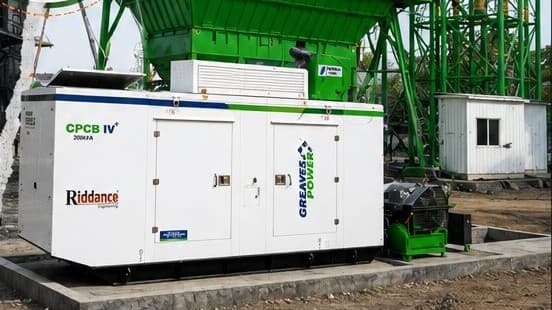
Riddance Engineering's Job at an RMC Plant, and Why a Batching Line Can't Lose Power
GensetPedia Technical Desk · · 4 min read
The take
Riddance Engineering put a CPCB IV+ Greaves set into a ready-mix concrete plant. A factory that loses power loses hours. A concrete plant loses the batch, because the concrete keeps setting while the plant stands still. That is what the generator is there to prevent, and it is why choosing and placing it takes more thought than the rating suggests.
A Greaves set at a concrete plant
Riddance Engineering has put a CPCB IV+ generating set into a ready-mix concrete plant. It stands outdoors on its own plinth, in an acoustic enclosure, with the batching tower and the cement silos behind it.
Riddance are a Greaves dealer in Dombivali, east of Mumbai, and have been since 2009. They also make their own electrical panels and acoustic enclosures.
It looks like an ordinary industrial installation. It is not, and the reason is the customer.
Concrete does not wait
Most factories can take a short power cut. Work stops, work starts again, and what you lose is time.
A concrete plant cannot. The moment the mixing water meets the cement, the concrete starts setting, and nothing at the plant can stop that. A load of ready-mix has roughly two hours from that point to being discharged. The clock starts at the plant, not when the truck leaves.
So a plant that stops mid-cycle is not waiting out the power cut. It is using up that time on concrete nobody is placing. Ten minutes is a nuisance. Fifty minutes and the mixer load, plus every load already sitting in trucks in the yard, has lost the same fifty.
The usual fix is to add water and get the load moving again. It works for a moment, and it takes strength out of the finished slab.
The cost then lands on the customer. A truck is meant to be emptied within about half an hour of reaching site. If it arrives too late for the pour, that is a problem for the site engineer, not just a late delivery.
That is the customer Riddance took on here.
Why it is harder to choose than it looks
Two things make a batching plant demanding.
First, the air. The silo valves, the cement gates and the mixer discharge door are all pneumatic. If the compressor stops, the plant cannot open or close anything, even after the motors are back. The compressor has to be on the generator.
Second, the restart. The mixer is sitting half full, and it has to be started direct-on-line into a drum that is not empty. That is the heaviest single demand the plant will ever make, and it comes at the worst moment.
So the generator is not chosen from what the plant draws while it is running. It is chosen from what it has to absorb in one step, which is always more. Plant makers know this and publish a recommended generator rating well above the plant's connected load.
Getting that right is the part of the job nobody thanks a supplier for. Get it wrong and the set trips on the first restart, in front of the customer.
Where it stands matters as much
A concrete yard is a hard place for a generator. Cement and aggregate dust all day, mud in the monsoon, transit mixers turning nearby.
Riddance's set stands clear of it, raised on its own plinth with the enclosure intact. How high that plinth sits, which way the intake and exhaust face, how much room the radiator has and who cleans it before it chokes — all of that is settled at installation, and it decides whether the set reaches its overhaul interval. Our installation checklist covers the same ground for any site.
Doing work worth writing about? We publish installations that took real thought, and we credit the people who did them. If you are a dealer, an OEM or an installer with a job a buyer could learn from, tell us about it. There is no charge and no advertising arrangement.
GensetPedia is independent. We are not affiliated with Riddance Engineering or Greaves Cotton, have no referral arrangement with either, and earn nothing if you contact them. We have not verified the rating of the set shown or the plant it serves.
Why it matters
Backup power at a batching plant is usually bought as insurance against lost hours, and priced that way, which is why it often ends up too small. What it actually protects is the batch in the mixer and the delivery it was meant to become. Sizing it means looking at what the plant has to restart, not what it draws while running.
Frequently asked questions
Why can't a concrete batching plant lose power?+
Because the concrete keeps setting while the plant is stopped. The plant also loses its compressed air, and the silo valves, cement gates and mixer door all run on air, so it cannot open or close anything even after the motors come back. And every delayed truck delays the customer's pour.
Who installed the generator at this RMC plant?+
Riddance Engineering, a Greaves dealer based in Dombivali, east of Mumbai, working since 2009. The company also makes its own electrical panels, acoustic enclosures and soundproof rooms, and handles RECD retrofits and annual maintenance contracts.
How long can concrete sit before it has to be discharged?+
About two hours from the time the mixing water is added, with some allowance for retarders and cool weather. The clock starts at the plant, not when the truck leaves. On site, a truck is expected to be emptied within about half an hour of arriving.
What size generator does a concrete batching plant need?+
More than the plant's running load. Plant makers publish a recommended generator rating for each model and it always sits above the connected load, because the mixer has to restart direct-on-line into a drum that is not empty. Add anything the plant figure leaves out — a chiller or ice plant, transit mixers, the wash bay, lighting and the office.
Found this useful?
Follow GensetPedia on LinkedIn for more genset buying guides and industry data.
Get the weekly digest
New buying guides and market data, once a week — no spam.