Buying Guides
Generator for Home in India: Size, Silent, Diesel or Petrol

GensetPedia Technical Desk
· 9 min read
The take
A generator for home in India is sized by what has to start on it, not by how many rooms you have. Lights, fans, a fridge, a TV and a laptop add up to about 1 kW running on this site's load calculator, which a small set covers. A 1 HP pump or a 1.5 ton AC is what pushes a home to 5 kVA and beyond. Every new diesel genset up to 1000 kVA must, by law, come in an acoustic enclosure and stay within 75 dB(A) at 1 metre, so a new diesel set for home is a silent set by default. Petrol suits short, occasional cuts and small loads; diesel suits long or daily cuts and anything with a motor.
A generator for home is not sized by the number of bedrooms. It is sized by two numbers: the watts that run together during a power cut, and the surge the biggest motor draws when it starts. Get those two right and the choice between silent or open, diesel or petrol, mostly makes itself.
This guide works through both numbers with real examples, then puts a real diesel home set next to real petrol portables, using only what the makers publish.
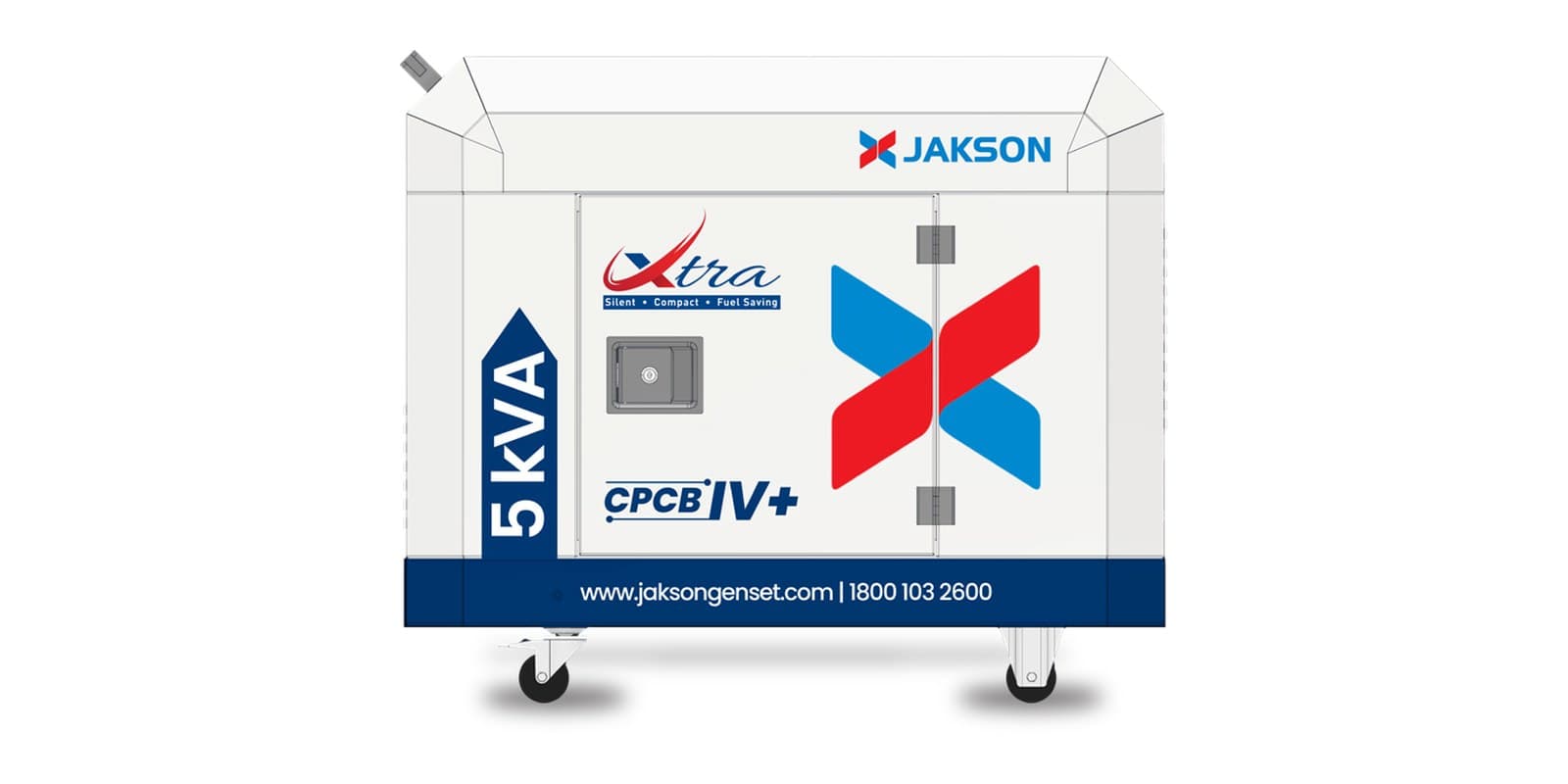
Photo: Jakson Genset, from jaksongenset.com.
What size generator for home do you need?
Start with a list of what must stay on during a cut. The figures below are the typical running watts in GensetPedia's load calculator, which you can edit to match your own appliances.
| Appliance | Typical running watts | Starting surge counted? |
|---|---|---|
| LED bulb or tube light | 15 W each | No |
| Ceiling fan | 75 W each | No |
| Refrigerator, double door | 250 W | Yes, it has a compressor |
| LED TV, 42 inch | 120 W | No |
| Laptop | 65 W | No |
| Water pump, 1 HP | 1,000 W | Yes |
| Split AC, 1.5 ton | 1,650 W | Yes |
| Geyser | 2,000 W | No, but it is a large steady load |
The calculator treats every motor (pump, compressor, washing machine) as drawing three times its running power for the moment it starts, which is a conservative direct-on-line assumption. It then sizes for whichever is bigger, the running load or the load at the moment the largest motor starts, adds a 25% margin, and rounds up to a standard size.
Here is what that does to three common homes:
| Home on backup | Running load | Worst moment (largest motor starting) | With 25% margin | Standard size |
|---|---|---|---|---|
| 10 LED lights, 5 fans, fridge, TV, laptop | 960 W = 1.2 kVA | fridge starting: 1.83 kVA | 2.28 kVA | 5 kVA (smallest on the calculator) |
| The same, plus a 1 HP water pump | 1,960 W = 2.45 kVA | pump starting: 4.95 kVA | 6.19 kVA | 7.5 kVA |
| The first home, plus one 1.5 ton split AC | 2,610 W = 3.26 kVA | AC starting: 7.39 kVA | 9.23 kVA | 10 kVA |
All kVA figures use 0.8 power factor, the rating basis printed on the diesel genset brochures this site has checked. Our kVA to kW guide explains the conversion.
In a home, the pump or the AC compressor sizes the generator. Running watts double with one pump; the size the calculator recommends goes from 5 to 7.5 kVA because of a few seconds of starting current.
Two practical moves follow from the table. If the overhead tank can be filled before or after the cut, keep the pump off the generator. And if an AC must run, ask its maker for the starting current, because the 3× assumption is deliberately cautious. Jakson, for one, says its 5 kVA set can run one AC together with lights, fans, a fridge, a TV and a washing machine, with a footnote that actual performance depends on appliance efficiency and usage.
Silent or not: what the law already decides
For diesel, the choice is mostly made for you. India's noise limit for diesel generator sets, notified under the Environment (Protection) Rules (GSR 371(E) of 2002 and its amendments), says:
- every new diesel generator set up to 1000 kVA, made on or after 1 January 2005, must not exceed 75 dB(A) at 1 metre from the enclosure surface;
- the set must have an integral acoustic enclosure at the manufacturing stage itself;
- each model needs a type approval certificate and yearly conformity of production, and must carry a conformance label stating "75 dB(A) at 1 m";
- no one may sell, import or use a model without those certificates.
So a new diesel generator for home, bought from a maker's channel, is a silent genset. Kirloskar's 7.5–20 kVA CPCB IV+ brochure states "≤75 dBA at 1 meter (genset with canopy)" for every model in the range. Jakson's 5 kVA page lists "≤ 68 dB(A)" without stating the distance. The older open-frame sets still on the second-hand market are a different story, and our open-frame vs silent genset guide covers why they are no longer the default.
Petrol portables are not covered by that diesel rule. Honda says its EX2400S "Silent series" set meets CPCB standards and that the EU70is conforms to CPCB emission norms and Noise Regulation Phase-II. Honda lists noise at 86–87 dB for its four models without giving the measuring distance, so those figures cannot be set against the 75 dB(A) at 1 m diesel figure; ask the dealer for the test certificate of the exact model.
Diesel or petrol: the makers' own numbers
Here are four real machines a home buyer would actually look at, two diesel and two petrol, with figures as published.
| Jakson 5 kVA | Kirloskar KG4-7.5SAS1 | Honda EU30is | Honda EU70is | |
|---|---|---|---|---|
| Fuel | Diesel | Diesel | Petrol | Petrol |
| Rated output | 5 kVA / 4 kW | 7.5 kVA / 6 kW (prime) | 2.8 kVA (3 kVA max) | 5.5 kVA (7 kVA max) |
| Phase | 230 V single-phase | 230 V 1Ø and 415 V 3Ø listed for the range | Single-phase | Single-phase |
| Engine | 418 cc, 1 cylinder, air-cooled | 0.95 L, 1 cylinder, air-cooled, 1500 rpm | GX200, 196 cc | GX390, 389 cc |
| Fuel tank | 12 L | 50 L | 12.5 L | 19.2 L |
| Running time per tank | 8–10 h | Not published | 6.9 h at rated output | 6.5 h at rated output |
| Weight | 85 kg net | 620 kg dry | 63.5 kg | 123.2 kg |
| Size (L × W × H) | 650 × 500 × 550 mm | 1310 × 810 × 1600 mm | 710 × 482 × 570 mm | 1261 × 680 × 722 mm |
| Emission norm stated | CPCB IV+ (on the canopy) | CPCB IV+ | "Conforms to CPCB Norms 2014" badge on Honda's leaflet | The same badge; Honda's page adds CPCB emission norms and Noise Regulation Phase-II |
Sources: Jakson's 5 kVA genset page and leaflet (jaksongenset.com); Kirloskar Oil Engines' 7.5–20 kVA CPCB IV+ brochure; Honda India Power's portable generator leaflet and product pages, as compiled on our Honda 0.85–7 kVA portable page.
What the table says, in plain words:
Run time is the real difference. Jakson publishes 1.2 litres an hour at 75% load from a 12 litre tank, which is the 8–10 hours it quotes. Honda's petrol models run 6.5 to 7.6 hours at rated output on their tanks. For a two-hour evening cut either works. For a ten-hour cut, the petrol set needs a refill and someone to do it.
A small diesel set is no longer a 600 kg machine. Jakson's 5 kVA weighs 85 kg on castors, lighter than Honda's EU70is at 123.2 kg. Kirloskar's 7.5 kVA, at 620 kg, is a different kind of product: a fixed installation for a bungalow with a heavier load, with a 500-hour oil change period and a prime rating that Kirloskar describes as "designed for unlimited hours".
Rated versus maximum. Honda badges its sets by maximum output: the EU70is says 7 kVA and is rated at 5.5 kVA. Diesel genset brochures quote the prime rating. Compare rated with rated, or a "7 kVA" petrol portable looks bigger than it is.
Inverter petrol sets suit electronics and light loads. Honda's EU30is and EU70is are inverter models, and both can be linked in parallel with Honda's cable (5.6 kVA rated for two EU30is, 11 kVA for two EU70is), which is a way to grow without buying one large set.
Which one for which home
| Your situation | What usually fits |
|---|---|
| Short, rare cuts; lights, fans, fridge, TV, Wi-Fi | A small petrol inverter set, or an inverter/UPS battery. Our genset vs inverter/UPS guide compares the two. |
| Daily cuts of several hours, single-phase supply, one AC or a small pump | A 5 kVA single-phase diesel set |
| A bungalow with a pump, two or more ACs, or a three-phase supply | 7.5–15 kVA diesel, sized on the calculator; check single or three phase first with our single-phase vs three-phase guide |
| A housing society's common load (lifts, pumps, corridors) | A building-level set; see sizing a genset for an apartment society |
Before you buy: five checks
- Run your own list through the load calculator. Turn the pump and AC on and off to see what each one costs you in kVA.
- Read the rated output, not the badge. On petrol portables the badge is often the maximum.
- Check the label. A new diesel set must carry the conformance label with "75 dB(A) at 1 m" and a type approval number. If it has none, do not buy it.
- Match the phase to your electricity connection.
- Plan where it will stand and how it will connect. A generator connected to house wiring needs a changeover switch so it never feeds back into the grid, plus proper earthing and ventilation; our genset installation checklist covers the site work.
For larger sizes, the spec data on this site covers real home-scale diesel sets such as the TMTL 7.5 kVA and the Jakson 15 kVA, and you can compare models side by side on tank size, noise and emission norm.
Specifications are quoted as published by Jakson, Kirloskar Oil Engines and Honda India Power on the dates read (October 2026); the noise rule is quoted from the Environment (Protection) Rules text as published by the Puducherry Pollution Control Committee. Load figures are this site's calculator defaults. Always confirm the final rating and fitment with the manufacturer or an authorised dealer.
Why it matters
Buy too small and the set stalls the first time the pump or the AC compressor kicks in. Buy too big and you carry a heavier, costlier machine that runs lightly loaded for years. Pick the wrong fuel and you either refill a petrol tank every few hours or park a 600 kg diesel set where a portable would have done.
Specs for the sizes in this article
Frequently asked questions
What size generator for home do I need in India?+
Add up the running watts of everything you want on backup, then check the biggest motor that has to start on the generator. On GensetPedia's load calculator, lights, fans, a fridge, a TV and a laptop come to 960 W running and size to the smallest standard set, 5 kVA, with margin to spare. Add a 1 HP water pump and the result is 7.5 kVA; swap the pump for a 1.5 ton split AC and it is 10 kVA, because the calculator assumes a motor draws three times its running power while starting.
Is a silent generator for home required by law?+
For diesel, yes in effect. Under the Environment (Protection) Rules, every new diesel generator set up to 1000 kVA made on or after 1 January 2005 must have an integral acoustic enclosure from the factory and must not exceed 75 dB(A) at 1 metre from the enclosure surface. It must carry a type approval and a conformance label stating that limit.
Diesel or petrol generator for home: which is better?+
Petrol portables are light and quick to move but have small tanks: Honda lists 6.5 to 7.6 hours at rated output across its four models. A diesel home set is heavier and is usually placed once, but runs longer per fill: Jakson lists 8 to 10 hours from a 12 litre tank on its 5 kVA set. For long or daily cuts, or loads with motors, diesel is the usual choice; for short, rare cuts and light loads, petrol is enough.
Can a 5 kVA generator run an AC at home?+
Jakson says its 5 kVA diesel set can run one air conditioner along with lights, fans, a fridge, a TV and other essentials, with a footnote that actual performance depends on appliance efficiency and usage. Check the AC's own starting current with its maker before you rely on it, because starting surge, not running power, decides whether the set holds.
Should a home generator be single-phase or three-phase?+
Match it to your supply. A home on a single-phase connection needs a single-phase set or a three-phase set wired for single-phase use. Jakson's 5 kVA is single-phase 230 V only; Kirloskar's 7.5 to 20 kVA range is listed for both 230 V single-phase and 415 V three-phase.
Is the rated or the maximum kVA the one to size with?+
The rated figure. Portable petrol sets often carry the maximum on the badge: Honda's EU70is is badged 7 kVA but is rated at 5.5 kVA, and its EU30is is badged 3 kVA and rated at 2.8 kVA. Size your load to the rated output.
Found this useful?
Follow GensetPedia on LinkedIn for more genset buying guides and industry data.
Get the weekly digest
New buying guides and market data, once a week — no spam.